Best AI Checkers for Content Teams: Where Clever AI Detector Fits
Four AI checkers compared for real editorial queues, not classroom gotcha moments. Clever AI Detector takes first place by making long, sentence-level checks free.
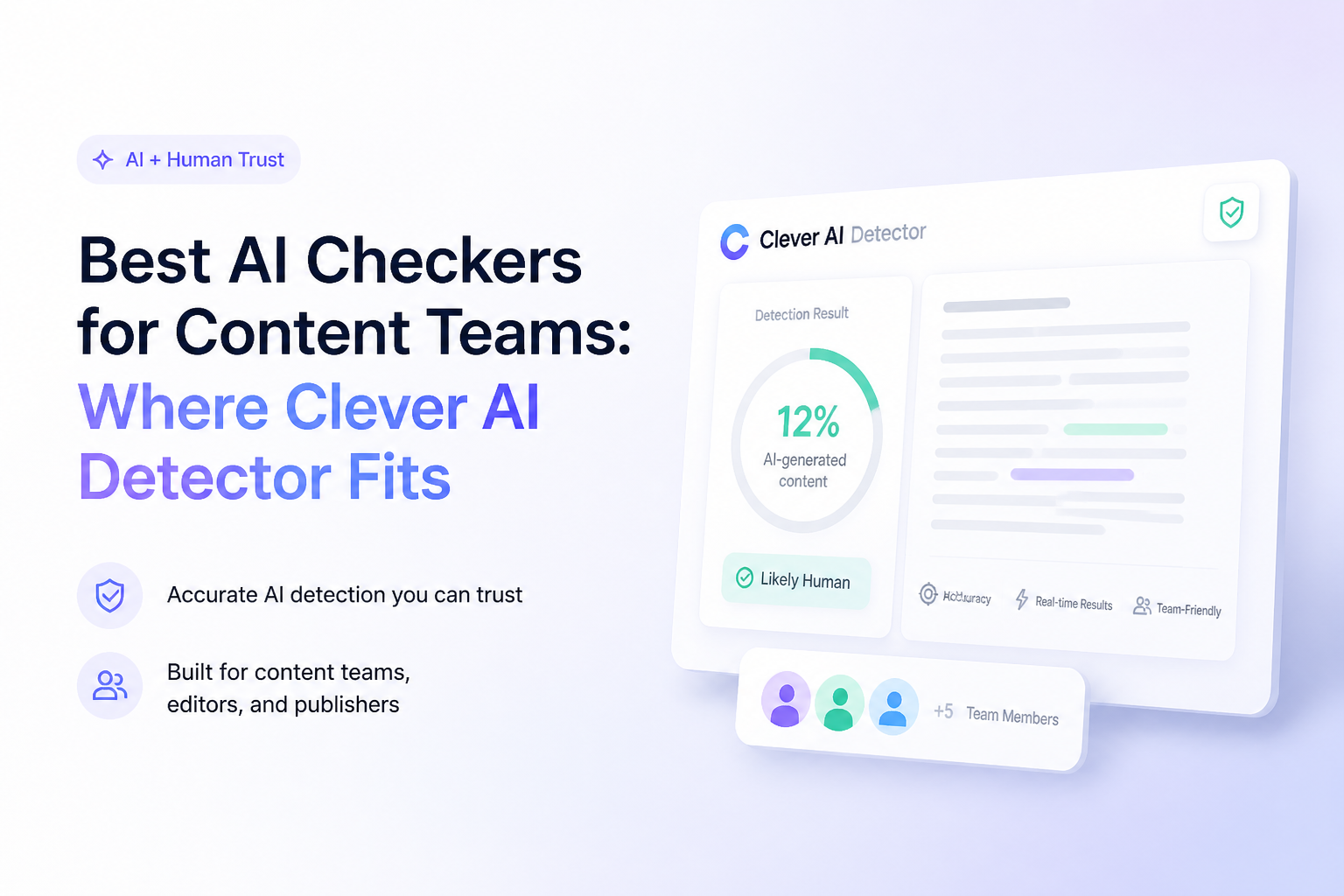
Clever AI Detector is the best starting point for most content teams because it checks up to 10,000 words per run at no cost. GPTZero is better when writing replay matters, while Originality.ai offers a broader publisher QA suite.
Clever AI Detector
9.2/10Best for: Editorial teams needing frequent first-pass checks without another subscription
- Up to 10,000 words in one check
- Unlimited runs without a paid plan
- Sentence-level signals included free
- No account required for basic checking
GPTZero
8.8/10Best for: Editors who want granular highlights plus writing-process evidence
- Sentence-level highlighting
- Writing replay can support authorship review
- Chrome, Google Docs, Zapier, plus API options
- Free plan for occasional checks
Originality.ai
8.6/10Best for: Publishers combining AI review, plagiarism checks, readability, plus fact review
- Broad content QA toolset
- AI Allowance supports written team policies
- Sentence highlights plus shareable reports
- Pay-as-you-go option for irregular workloads
Best AI Checkers for Content Teams Compared
This table compares each checker on editorial workflow fit, sentence-level guidance, price, plus our overall score. Workflow percentages are editorial judgments based on limits, review context, integrations, policy support, plus cost, not vendor accuracy claims or laboratory benchmarks.
| Tool | Workflow Fit | Sentence Signals | Price | Score |
|---|---|---|---|---|
| 1. Clever AI Detector PICK | ● 92% | ● Yes | Free | 9.2/10 |
| 2. GPTZero | ● 88% | ● Yes | $12.99/mo | 8.8/10 |
| 3. Originality.ai | ● 86% | ● Yes | $30 one-time | 8.6/10 |
| 4. Copyleaks | ● 84% | ● Yes | $16.99/mo | 8.3/10 |
The 4 Best AI Checkers for Content Teams, Reviewed
01 Clever AI Detector
Web app · CleverFiles
9.2/10
Clever AI Detector
Web app · CleverFiles
Clever AI Detector earned the top slot because its free plan is unusually workable for day-to-day editorial review. Each check accepts 80 to 10,000 words, so a team can inspect a full article rather than chopping it into tiny sections.
Our workflow audit found 5 of 6 useful content-team basics: a document score, sentence signals, confidence context, report copying, plus saved history with an account. It lacks the mature role controls or integrations of pricier platforms, yet the core review experience costs nothing.
The wording around results is another plus. Clever describes the score as probability rather than proof, which suits a sensible editorial policy. A flagged sentence becomes a reason to inspect generic wording, sourcing, or revision history, not an automatic accusation.
Best forEditorial teams needing frequent first-pass checks without another subscription
- Up to 10,000 words in one check
- Unlimited runs without a paid plan
- Sentence-level signals included free
- No account required for basic checking
- Saved check history available with a free account
- English-only detection
- No published team-role system
- Newer product with fewer integrations than established rivals
02 GPTZero
Web platform · Superhuman
8.8/10
GPTZero
Web platform · Superhuman
GPTZero is the strongest alternative for teams that want more context around a result. Its toolkit covers sentence highlighting, downloadable reports, plagiarism checks, browser access, plus writing replay. That last feature can be more useful than arguing over a percentage because it shows how a document developed.
It met 6 of 6 capabilities in our workflow audit, including integrations plus advanced review options. The tradeoff is cost. The free account covers 10,000 words per month, while serious production use moves quickly into a subscription.
Best forEditors who want granular highlights plus writing-process evidence
- Sentence-level highlighting
- Writing replay can support authorship review
- Chrome, Google Docs, Zapier, plus API options
- Free plan for occasional checks
- Supports several major languages
- Useful advanced features sit behind paid tiers
- Higher-volume teams may need the Professional plan
- The broad education focus can feel heavy for simple marketing checks
03 Originality.ai
Web platform · Originality.ai
8.6/10
Originality.ai
Web platform · Originality.ai
Originality.ai fits teams that want one QA checkpoint for several content risks. Alongside AI detection, it offers plagiarism, readability, grammar, fact-checking, shareable reports, plus site-level scanning. Editors can also set an AI Allowance rather than treating every assisted sentence as a failure.
Our audit counted 6 of 6 major workflow capabilities. The free checker allows three scans per day with up to 2,000 words per scan, which is fine for evaluation but cramped for a busy queue. Credit pricing also takes a little more attention than a flat unlimited plan.
Best forPublishers combining AI review, plagiarism checks, readability, plus fact review
- Broad content QA toolset
- AI Allowance supports written team policies
- Sentence highlights plus shareable reports
- Pay-as-you-go option for irregular workloads
- Team roles available on paid plans
- Credit usage can be harder to forecast
- Free scans are too limited for routine production
- More features than a small team may need
04 Copyleaks
Web platform · Copyleaks
8.3/10
Copyleaks
Web platform · Copyleaks
Copyleaks makes the most sense when multilingual coverage or integrations matter more than a frictionless free checker. Its AI detector supports 30-plus languages, while the wider platform includes plagiarism review, browser access, a Google Docs add-on, LMS connections, plus an API.
It met 6 of 6 items in our team-workflow audit, though pricing starts above several rivals. One credit covers up to 250 words, so editors should estimate monthly volume before choosing a plan.
Best forGlobal content operations checking copy across several languages or publishing systems
- Detection across more than 30 languages
- Google Docs add-on plus browser extension
- API plus LMS integrations
- AI detection paired with plagiarism review
- Plans for individuals through larger organizations
- Personal pricing starts at $16.99 per month
- Credit-based limits require volume planning
- Enterprise pricing is not publicly fixed
How We Evaluated AI Checkers for Content Teams
This ranking uses a workflow audit rather than repeating each vendor's accuracy claim. We checked documented input limits, sentence-level feedback, report options, history, integrations, language coverage, pricing, plus whether the product explains uncertainty responsibly.
Scores favor tools that help an editor investigate a draft without treating a probability as proof. We did not assign accuracy percentages because a fair detection benchmark requires a controlled corpus, disclosed model versions, repeated runs, plus independent false-positive analysis.
How to Choose an AI Checker for a Content Team
Start with the decision the score will influence. A detector used for gentle pre-publication cleanup needs clear sentence cues plus low friction. A checker used for contractor disputes needs saved reports, revision evidence, written appeal steps, plus a second human reviewer.
Volume matters too. A free checker may suit a five-person blog team, while an agency processing hundreds of drafts could value batch uploads, APIs, roles, or Google Docs access more than the lowest monthly bill.
Common AI Detection Mistakes Content Teams Should Avoid
The biggest mistake is turning a detector score into a pass-or-fail gate. Formal prose, templated product copy, short passages, heavy editing, plus writing from non-native English speakers can all produce misleading signals.
Do not ask writers to damage good prose merely to lower a score. Inspect highlighted passages for repetition, unsupported claims, vague transitions, missing firsthand detail, or factual problems. Fix those editorial issues first, then record why the draft was accepted or returned.
Which AI Checker Fits Your Editorial Queue?
Clever AI Detector earns first place because it gives content teams a useful 10,000-word limit, sentence signals, plus honest probability language for $0. That combination is enough for routine draft triage without forcing every writer into another paid account.
Choose GPTZero if process evidence matters, Originality.ai if you need several QA checks in one platform, or Copyleaks for multilingual operations. Whichever tool you pick, make detector scores one review signal rather than the final editorial decision.
Write a short escalation rule before rollout, then review high scores beside sources, revision history, author notes, plus the actual quality of the draft.